
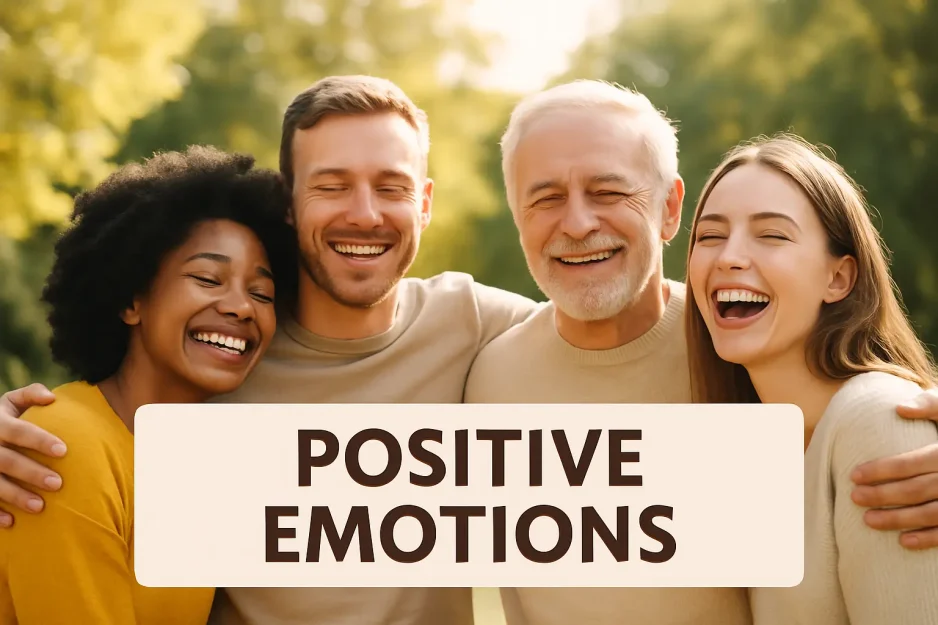
What makes us live longer and happier? Positive emotions. If negative emotions trigger negative chemical processes in the body, why shouldn’t positive ones trigger positive ones? Numerous studies have now shown that people who experience positive emotions also experience greater and lasting physical and mental well-being. Let’s see why:
Positive emotions, such as joy, serenity, altruism, contentment, and gratitude, can activate personal resources on the physical, social, and psychological levels. The more we cultivate these emotions, the more we naturally combat their opposites.
Experiencing positive emotions improves our ability to learn and problem-solve, becomes more creative, sees greater opportunities, opens our minds, and thus broadens our range of thought. It increases resilience, but also improves our immune and cardiovascular systems, and our emotional connection with others.
Perceiving the positive emotions of others increases self-esteem and the production of one’s own positive emotions: one feels considered, loved, appreciated, and supported. Furthermore, by turning more attention to others, one “forgets” about oneself: while depressed people withdraw into themselves, fueling feelings of loneliness and sadness, altruism, gratitude, and affection encourage openness to others.
This disposition fosters prosocial behavior and increases trust in others, even strangers. This explains why individuals prone to experiencing positive emotions more easily create a high-quality, lasting, and satisfying social network, which increases their sense of well-being.
Just as, over the long term, negative emotions can lead to chronic stress and trigger a downward spiral, positive emotions, if cultivated, can create a spiral of positive growth in an individual’s resources, improving their well-being.
The Art of Being Happy
Psychologist Christopher Peterson of the University of Michigan, along with Martin Seligman, proposed a positive psychology approach, establishing a classification of positive human dispositions called “character strengths.” Cultivating these traits, and thus experiencing positive emotions, appears to improve mood, state of mind, and behavior, with positive effects on personal and relationship life. Here are the 24 traits:
- curiosity and interest in the world;
- desire to learn;
- open-mindedness, critical thinking;
- ingenuity, originality;
- foresight;
- courage and courage;
- perseverance, diligence;
- integrity, authenticity, sincerity;
- enthusiasm;
- love and attachment;
- kindness and generosity;
- social intelligence;
- sense of justice and loyalty;
- impartiality;
- respect for hierarchies;
- ability to forgive;
- humility and modesty;
- prudence and discretion;
- Self-control;
- appreciation of beauty;
- gratitude;
- hope, optimism, and openness to the future;
- joy and a sense of humor;
- spirituality, the search for meaning in life.